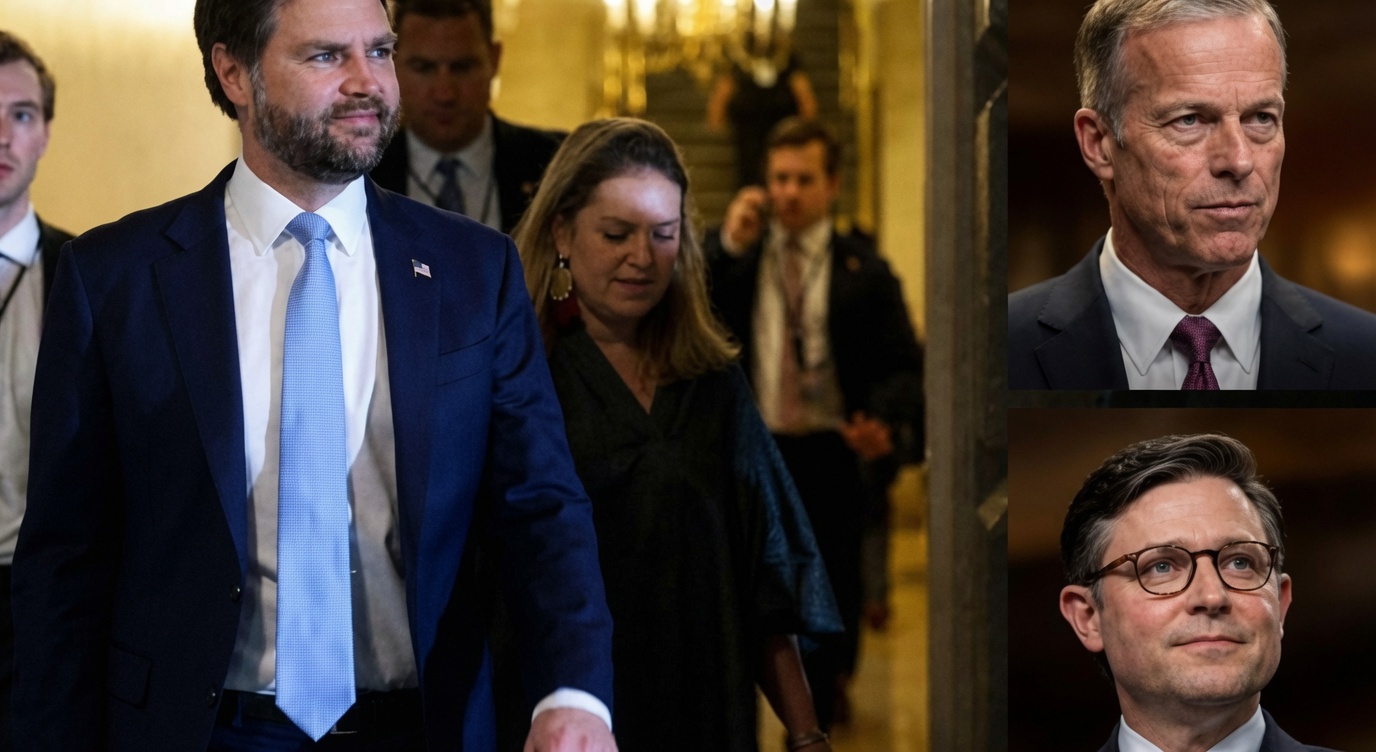
A renewed push to pass one of President Donald Trump’s top legislative priorities appears to be gaining momentum after Vice President JD Vance met Wednesday with House Speaker Mike Johnson to discuss a strategy that supporters hope could overcome Senate gridlock.
The meeting comes after months of stalled negotiations and signals that the White House is continuing to search for a path to enact the SAVE America Act before the 2026 midterm elections.
Vance joined Johnson during a House Republican conference meeting Wednesday to discuss the GOP’s latest reconciliation package, which Republican leaders have described as their best opportunity to advance the SAVE America Act with a simple Senate majority if procedural hurdles can be cleared.
Under the strategy, Republicans hope to use the budget reconciliation process, allowing certain legislation to pass the Senate with 51 votes instead of the usual 60.
If the Senate were split 50-50, Vice President Vance could cast the tie-breaking vote under the Constitution.
Speaking alongside Johnson, Vance argued the legislation is necessary to strengthen election integrity.
“In certain jurisdictions, illegal aliens are casting ballots,” Vance said.
He also criticized states that limit or prohibit certain voter identification requirements.
“There are a lot of big blue states that make that impossible — will in fact criminalize the act of asking for an ID in order to vote,” Vance said.
“Why would you criminalize asking for an ID in order to vote unless you wanted to encourage and promote cheating?”
Vance added that election integrity remains a top priority for the administration.
“So this is an important priority for the administration but more importantly it’s an important priority for the American people to save our elections. The way you save America is by bringing election integrity. It’s something that matters.”
He also criticized congressional Democrats for opposing the legislation.
“It’s a shame that the Democrats aren’t going to help us get this done given that a majority of Democrat voters actually want us to have election integrity in this country.”
The SAVE America Act would require documentary proof of U.S. citizenship when registering to vote in federal elections and would require voters to present identification when casting ballots in federal races.
Republican leaders have repeatedly described the legislation as one of President Trump’s highest legislative priorities.
Earlier this month, Johnson said House Republicans viewed reconciliation as their strongest opportunity to move the bill through Congress.
Even after the House approved the package, however, the proposal still faces procedural questions in the Senate.
Several Republican senators have acknowledged that portions of the SAVE America Act, as currently written, may not comply with the Senate’s Byrd Rule governing budget reconciliation.
Lawmakers have discussed modifying the legislation—including possible grant-based incentives for states—to improve its chances of surviving parliamentary review.
Democrats have opposed the legislation, arguing it could create barriers for eligible voters who do not readily have documentary proof of citizenship.
Republicans counter that the measure is necessary to protect the integrity of federal elections.
Whether the reconciliation strategy ultimately succeeds will depend on both the Senate parliamentarian’s rulings and whether Republican leaders can unite enough votes to move the legislation through the narrowly divided Senate.
For now, Wednesday’s meeting demonstrated that the White House is continuing to make the SAVE America Act a central legislative priority as Republicans search for a viable path to President Trump’s desk before the next national election.